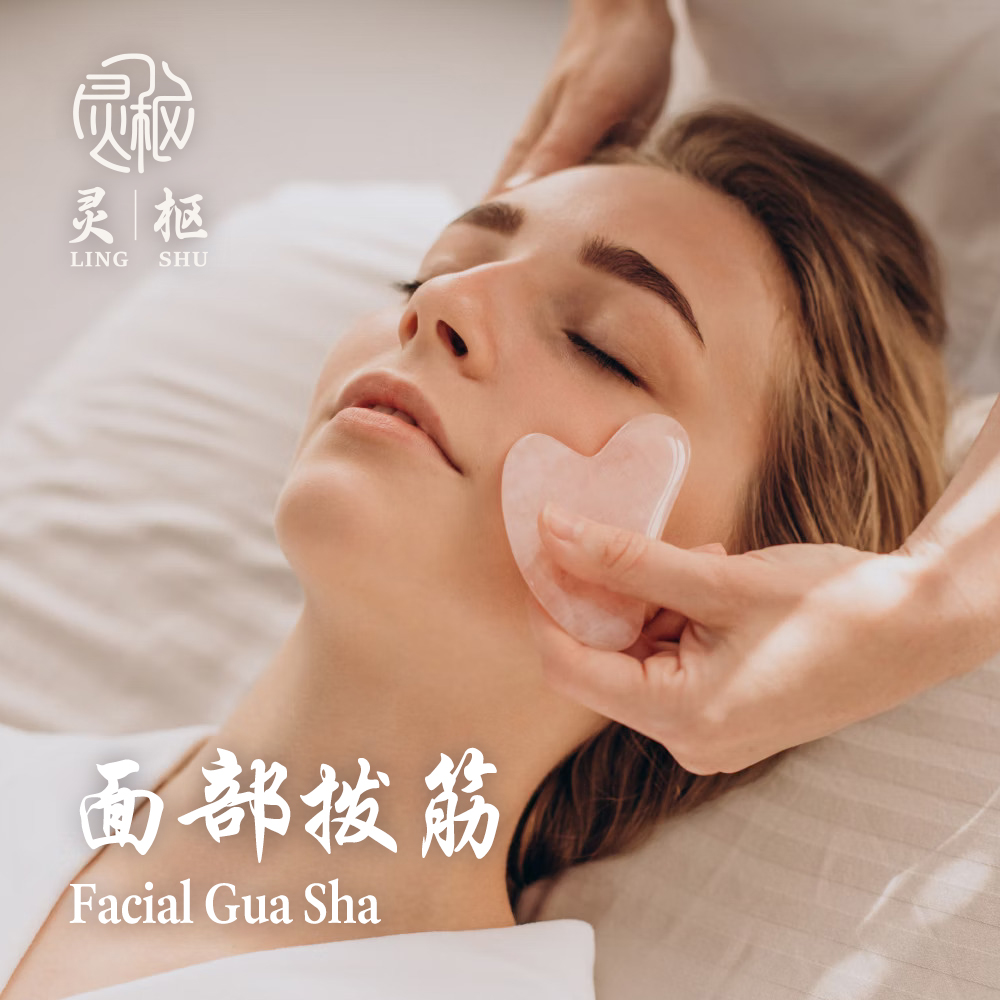
Facial gua sha uses the same tool and principle as body gua sha at a fraction of the pressure. Body gua sha is meant to raise redness; on the face it deliberately is not.
What happens during the treatment
You lie face up with your hair tied back. The face and neck are cleansed, and a cream is applied so the tool can glide without dragging. This is essential, as gua sha on dry skin will pull and irritate.
A smooth-edged tool, typically jade or stainless steel, is held nearly flat against the skin and drawn in short, repeated strokes: outward along the jawline towards the ear, across the cheekbone, upward over the brow, and then downward along the sides of the neck. Each line is repeated several times before moving on. The practitioner may spend extra time around the jaw muscles if you clench.
It feels like firm, slow, cool stroking. It should not scratch or sting. The skin usually pinks slightly and settles within an hour; visible red marks of the kind body gua sha leaves are not the aim on the face and would indicate too much pressure.
Why people book it
Tightness through the jaw and temples, a sense of puffiness around the eyes and cheeks in the morning, and general facial tension after long screen days. It may help relieve tension in the facial muscles and is commonly used to support a feeling of lightness in the face.
How often would I need to come back?
The effect of facial gua sha is short-lived by nature, so people who value it tend to come at regular intervals rather than work through a course with an endpoint. Whether that is worth doing at all, and how often, is discussed openly at assessment. This is a comfort treatment, and it should be booked on that basis rather than as a programme.
When it should be avoided
- Active acne, rosacea flare, eczema, dermatitis, cold sores or any broken or infected facial skin
- Recent facial cosmetic procedures, injectables, fillers, peels, laser or microneedling, until the interval your provider advises has passed
- Sunburn, or skin currently sensitised by retinoids or acids
- Anticoagulant use, bleeding disorders, or skin that bruises very readily
- Recent facial surgery or dental surgery, or unexplained facial swelling or a lump
- Any allergy to the cream used. Tell the practitioner beforehand
- Fever or acute infection
Afterwards
Mild pinkness for up to an hour is normal, and occasionally a small bruise where the skin is thin. Keep the face out of strong sun, and skip exfoliants and active skincare for the rest of the day. Makeup is best left off for a few hours.
Fuller reading: TCM and women’s health at LS TCM and the Knowledge Centre on acupuncture and related therapies.